Welcome to Your Blue Ocean Strategic Positioning System
Most consultants approach their job search like they're playing the lottery:
Applying to dozens of roles where they're competing against 250+ equally qualified candidates.
The result?
Months of frustration, generic rejections, and the sinking feeling that your consulting experience "doesn't count" in the real world.
Your job search shouldn't be a competition.
It should be a strategic positioning exercise where you become the only person solving a specific problem with your unique background.
That's what the Blue Ocean Framework does:
It transforms you from "another ex-consultant" into "the only person who can solve THIS problem for THESE companies."
Your ideal positioning sits at the intersection of 4 critical elements:
BLUE OCEAN POSITIONING =
(Career Capital + Personal Assets + Supporting Conditions) × Problem-Market Fit
Let me break down what each element means:
- Personal Assets: Your skills, experience, and network that make you solve problems differently/better than your peers (your unfair advantage)
- Career Capital: The strategic career path you're building toward (5-10 year vision)
- Supporting conditions: Conditions you value in a job (salary, travel, growth potential, etc.)
- Problem-Market Fit: The intersection of problems you want to solve and markets that pay for solutions
- Industry & Problem Selection: Which industry problem energizes you
- Market Validation: Where companies actively hire to solve this problem
How This System Works: 6 Exercises
This system guides you through 6 exercises that build on each other.
You'll complete exercises 1-5, then synthesize everything in Exercise 6 to create your strategic positioning statement and target company list.
Here's the logic flow:
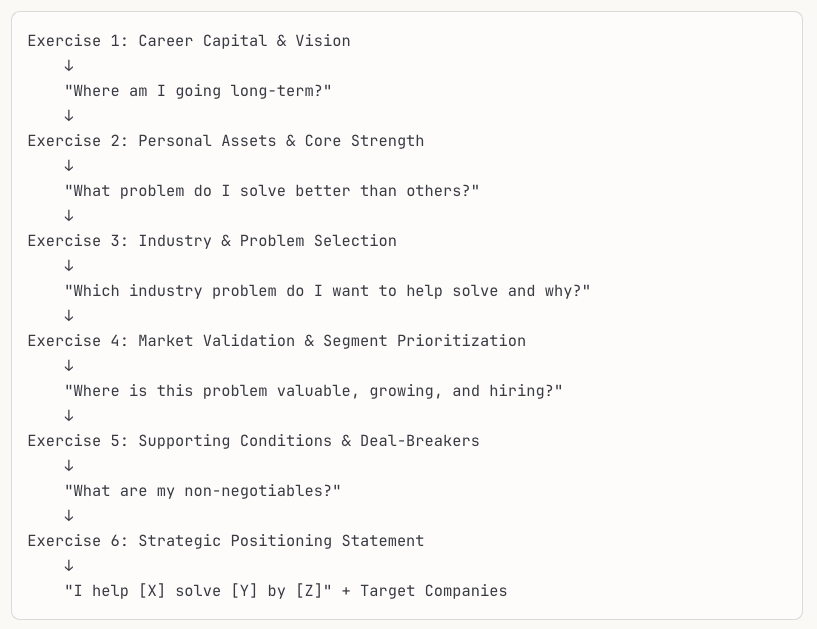
Each exercise serves a specific purpose and informs the next one.
You cannot skip steps.
Trying to craft your positioning (Exercise 6) without first understanding your career capital (Exercise 1) is like navigating without knowing your destination.
Exercise Overview: What Each One Accomplishes
Exercise 1: Career Capital & Vision
Objective: Define your 5-10 year career destination to ensure your next role is a strategic stepping stone, not just an optimized move.
Key Question: "What role do I want in 5-10 years, and what experiences must my next role provide to get me there?"
Output:
- Career track selection (CEO, CFO, COO, CMO, CPO, or PE)
- Target role (your next stepping stone)
- Critical skills/experiences needed to get there
Why This Comes First: Your Blue Ocean positioning should advance your long-term career, not just land you any job. This exercise ensures you're building toward something, not just escaping consulting.
Exercise 2: Personal Assets (unfair advantage)
Objective: Identify the ONE core problem you solve better than your peers and the specific way you solve it (your unfair advantage).
Key Question: "What do people call me for when projects are failing? How do I deliver results faster/better than others?"
Output:
- ONE core problem you solve (Growth Strategy, Scale Operations, or Fast Execution)
- ONE unfair advantage archetype (Problem Reframer, Hidden Value Spotter, Best Practice Translator, New Capability Importer, or Functional Translator)
- Validation: 3 specific client examples proving your advantage
Why This Matters: Generic "I'm a problem-solver" positioning doesn't work. You need a specific superpower that makes you irreplaceable for certain types of challenges.
Exercise 3: Industry & Problem Selection (the impact you want to have)
Objective: Choose which specific industry problem you want to solve based on your experience, interests, and personal conviction (this adds authenticity and direction to your positioning).
Key Question: "What industry problem keeps me reading articles at night? What change do I want to be part of?"
Output:
- 2-3 target industries (prioritized by genuine interest + consulting experience)
- Top 3 pressing problems in your #1 industry
- Personal connection statement: "I want to help [industry] solve [problem] because [reason]"
- THE ONE problem you're committing to focus on
Why This Matters: This is what makes networking conversations memorable and interviews compelling. You're not just qualified—you're motivated by this specific problem. This exercise is about CHOOSING your focus before validating the market.
Exercise 4: Market Validation & Segment Prioritization
Objective: Validate that a real opportunity exists for your chosen problem (from Exercise 3) in specific market segments—this prevents wasting time pursuing non-existent roles.
Key Question: "Are companies actually hiring to solve this problem right now? Can I name 15 companies by name that need this in growing, profitable segments?"
Output:
- Prioritized list of 3-5 market segments within your chosen industry (scored on: growth, profitability, your experience, your network, hiring trend, career capital fit)
- Validation: 10-15 specific companies by name hiring for this problem
- Evidence: 5+ job postings for relevant roles in the past 3 months
- Decision point: Does the market validate your Exercise 3 choice, or do you need to pivot to an adjacent problem?
Why This Matters: Brilliant positioning in a dead market = unemployment. This exercise validates your choice of problem in Exercise 3 with hard evidence. If the market doesn't validate, you'll return to Exercise 3 and choose an adjacent problem that still aligns with your interests but has stronger demand.
Relationship to Exercise 3: Think of these as "Choose" (Exercise 3), then "Validate" (Exercise 4). Exercise 3 is introspective = what do YOU want to work on? Exercise 4 is research-based = does the MARKET pay for this? Together, they create "Problem-Market Fit."
Exercise 5: Supporting Conditions & Deal-Breakers
Objective: Define your non-negotiable criteria to filter opportunities efficiently and avoid post-offer regret.
Key Question: "What would make me miserable even in an impressive role? What trade-offs am I willing to make?"
Output:
- Top 3 must-haves (ranked by importance)
- Top 2 deal-breakers (absolute non-negotiables)
- 2-3 acceptable trade-offs (e.g., "I'll accept 20% travel for +$30K salary")
Why This Matters: This prevents you from pursuing "prestigious" opportunities that don't fit your life, and gives you clarity to negotiate from strength.
Exercise 6: Strategic Positioning Statement & Target List
Objective: Synthesize Exercises 1-5 into a compelling, differentiated positioning statement and actionable target company list.
Key Question: "Can I articulate in one sentence exactly who I help, what problem I solve, and why I'm uniquely qualified, and can I name 15 specific companies that need this?"
Output:
- Blue Ocean Positioning Statement: "I help [specific market segment] solve [specific problem] by [unfair advantage] to achieve [specific outcome]"
- 3-5 target role titles
- 15 specific target companies (categorized: Tier 1 dream, Tier 2 strong fits, Tier 3 acceptable)
- Validation: Can name 3-5 people in your network at these companies
Why This Matters: This is your strategic brief for networking, resume writing, interview prep, and LinkedIn outreach. Everything else flows from this clarity.
Critical Success Factors
 Do the exercises in order - Each builds on the previous one
Be specific - "Tech companies" is too broad; "B2B SaaS $10-50M ARR" is specific
Pick ONE - Trying to keep multiple options open dilutes your positioning
Gather evidence - Your positioning must be based on reality, not wishful thinking
Think long-term - Your next role should be a stepping stone, not just any job
 Don't skip steps - Jumping to Exercise 6 without doing 1-5 produces generic positioning
Don't keep options open - "I could do strategy OR operations" = weak positioning
Don't ignore the market - Your dream positioning in a dead market = no offers
Don't choose what sounds impressive - Choose what energizes you and where you have proof
Exercise Details & Required Documents
Below you'll find the detailed requirements for each exercise, links to supporting documents, and the specific outputs you need to complete.
Your completion worksheet is included HERE. Print it out or complete it digitally, and upload it to your shared folder.
Exercise 1: Career Capital & Vision
Choose your career path and complete the exercise in the relevant document:
Path A: Corporate tracks
Path B: IB/PE tracks
Exercise 2: Personal Assets & Core Strength
Objective
Identify the ONE core problem you solve better than your peers and HOW you solve it differently (your unfair advantage archetype).
How to Complete
Note: check the videos and examples below.
Step 1: Identify YOUR Core Problem (Choose ONE)
Review the three real problems from the Blue Ocean framework:
Option 1: Growth Strategy (Where & How)
- You spot market opportunities others miss
- You naturally connect dots across trends
- You energize when thinking about "should we enter this market?"
- You naturally consume: industry trends, competitive moves, market reports
Option 2: Scale Operations (Orchestrating Complexity)
- You excel at M&A integration, carve-outs, and multi-workstream transformations
- You naturally see: patterns across moving parts, dependencies, system design
- You energize when making sense of chaos
- You naturally consume: operational case studies, organizational design content
Option 3: Fast Execution / Improve Efficiency
- You find inefficiencies others accept as "the way we do things."
- You naturally see: bottlenecks, redundancies, broken handoffs
- You energize when optimizing and measuring
- You naturally consume: process improvement methodologies, automation tools
Validation Test:
- Can you name 3 specific client situations where you solved this problem?
- Would former clients describe you this way?
- Does this feel energizing (not draining)?
Step 2: Identify YOUR Unfair Advantage Archetype (Choose ONE)
Review the five archetypes from the Blue Ocean framework:
The Problem Reframer
- You challenge what the problem actually is
- You ask "why are we solving this?" until you find the root cause
- Example: "The real problem isn't speed—it's that you're integrating before aligning on the business model"
The Hidden Value Spotter
- You find money/assets/capabilities the organization already has but doesn't see
- You spot "hidden treasure" in plain sight
- Example: "You have $15M tied up in duplicate vendors nobody's tracking"
The Best Practice Translator
- You transfer proven playbooks from Industry A to Industry B
- You have cross-industry pattern recognition
- Example: "I've seen this exact challenge in automotive—medical equipment is 5 years behind"
The New Capability Importer
- You bring a rare skill combination the organization lacks
- You're "bilingual" (speak Technical AND Business, or bridge functions)
- Example: "I combine data science + supply chain operations"
The Functional Translator
- You make warring departments work together
- You speak both sides' languages and build bridges
- Example: "I help Finance and Marketing collaborate by building models both teams trust"
Decision Tree:
- Do you most often change WHAT problem gets solved? → Problem Reframer or Hidden Value Spotter
- Do you most often change HOW it gets solved? → Best Practice Translator, New Capability Importer, or Functional Translator
Validation Test:
- Can you name 3 specific examples where you used this advantage?
- Would former colleagues describe you this way?
- Does this feel energizing (not something you force)?
Step 3: Write Your One-Sentence Summary
"I deliver results faster than peers because [specific reason based on your archetype]"
Examples:
- "...because I diagnose the root cause while others treat symptoms" (Problem Reframer)
- "...because I find money already in the business instead of requiring new investment" (Hidden Value Spotter)
- "...because I've already solved this in automotive, which is 5 years ahead" (Best Practice Translator)
- "...because I combine data science + operations, eliminating the handoff failure" (New Capability Importer)
- "...because I make Finance and Marketing actually collaborate instead of fighting" (Functional Translator)
Examples
To successfully complete the above exercises, you must go beyond just ticking boxes. Instead, you must translate, using your own words, what problem you solve better than others, and what your unfair advantage archetype means in the "real world". Be as SPECIFIC as possible.
To help you, you can check the examples below.
Here are 5 detailed examples showing different combinations of problems and unfair advantages:
EXAMPLE 1: Growth Strategy + Problem Reframer
Exercise 1 - The Problem I Solve:
 Growth Strategy (Where & How)
☐ Scale Operations (Orchestrating Complexity)
☐ Improve Efficiency / Fast Execution
Core expertise:
- Market entry strategy for companies expanding into adjacent segments
- Reframing "should we enter this market?" into "what customer problem are we uniquely positioned to solve?"
The ONE problem:
Companies waste 12-18 months and millions of dollars chasing market opportunities that look attractive on paper but don't align with their actual capabilities. They ask "can we win in this market?" when they should be asking "what problem do customers have that our unique assets solve better than anyone else?"
Competitors:
- Strategy consultants who run market sizing and competitive analysis
- Business development teams who chase whatever looks like a big TAM
- Corporate development teams focused on M&A rather than organic entry
Exercise 2 - My Unfair Advantage:
[One sentence explaining WHY you're better than peers]
I reframe market entry from "where can we compete?" to "what customer pain can we uniquely solve?" by connecting dots between a company's hidden capabilities and unmet market needs, even when:
- The leadership team is already convinced they know the right market
- The obvious adjacency looks more attractive than the real opportunity
- Internal politics favor entering markets where executives have existing relationships
EXAMPLE 2: Improve Efficiency + Hidden Value Spotter
Exercise 1 - The Problem I Solve:
☐ Growth Strategy (Where & How)
☐ Scale Operations (Orchestrating Complexity) Improve Efficiency / Fast Execution
Core expertise:
- SG&A cost optimization in companies that have "already cut everything we can cut"
- Finding money trapped in vendor contracts, duplicate systems, and fragmented procurement
The ONE problem:
CFOs are told "we've already done zero-based budgeting" or "we're running lean," but companies still have 15-30% of addressable spend that's invisible because it's not centrally managed. Money is trapped in: decentralized vendor contracts with 40% price variation for the same service, shadow IT spending that never hit procurement, and redundant subscriptions nobody remembers buying.
Competitors:
- Cost consultants who do traditional procurement optimization
- Finance teams who run budget cuts (but can't see decentralized spend)
- Category managers who optimize their category (but miss cross-category duplicates)
Exercise 2 - My Unfair Advantage:
[One sentence explaining WHY you're better than peers]
I find hidden money by tracing spend patterns across disconnected systems and uncovering duplicates that business units don't realize exist, even when:
- The company has "already done a cost transformation"
- Spend data lives in 5+ systems with different coding structures
- Business units insist "our situation is different" and resist consolidation
EXAMPLE 3: Growth Strategy + Best Practice Translator
Exercise 1 - The Problem I Solve:
Growth Strategy (Where & How)
☐ Scale Operations (Orchestrating Complexity)
☐ Improve Efficiency / Fast Execution
Core expertise:
- Building subscription/recurring revenue models in industries that traditionally sell one-time products
- Importing product-led growth playbooks from SaaS into non-tech industries
The ONE problem:
Traditional B2B companies (manufacturing, industrial equipment, professional services) watch their margins compress while software companies with inferior products capture their customers through subscription models. They know they need to shift from "sell a thing once" to "ongoing relationship," but they don't know how to price, package, or deliver services without cannibalizing their current business or confusing their sales team.
Competitors:
- Industry insiders who know the current business model deeply (but haven't seen the subscription playbook work elsewhere)
- SaaS consultants who know subscription models (but don't understand industrial/B2B constraints)
- Innovation teams who propose pilots (but can't get sales to actually sell them)
Exercise 2 - My Unfair Advantage:
[One sentence explaining WHY you're better than peers]
I translate proven SaaS subscription playbooks into traditional B2B contexts by adapting pricing, packaging, and go-to-market strategies to industries where "recurring revenue" sounds impossible, even when:
- Sales teams are 100% commission-based and resist changing how they sell
- Products have 20+ year replacement cycles (making subscriptions seem absurd)
- Finance teams panic about revenue recognition changes
EXAMPLE 4: Scale Operations + Functional Translator
Exercise 1 - The Problem I Solve:
☐ Growth Strategy (Where & How) Scale Operations (Orchestrating Complexity)
☐ Improve Efficiency / Fast Execution
Core expertise:
- Making Product and Finance actually work together (instead of fighting over roadmap prioritization)
- Building models and frameworks that both technical and financial teams trust
The ONE problem:
Product teams build features Finance thinks are worthless, while Finance kills products customers desperately need. The war happens because Product speaks in user stories and NPS, Finance speaks in IRR and payback periods, and neither side has a framework to evaluate trade-offs together. Projects get approved based on who lobbies harder, not what creates the most value.
Competitors:
- Product managers who build business cases (but Finance doesn't trust their assumptions)
- FP&A teams who create financial models (but Product thinks they don't understand the customer)
- PMO leaders who try to create frameworks (but nobody actually uses them)
Exercise 2 - My Unfair Advantage:
[One sentence explaining WHY you're better than peers]
I build prioritization frameworks that both Product and Finance buy into by translating user impact into financial terms and financial constraints into product trade-offs, even when:
- Teams have years of mutual distrust and dismissiveness
- Product insists "you can't put a number on customer satisfaction"
- Finance insists "we need hard ROI or it doesn't get funded"
EXAMPLE 5: Improve Efficiency + New Capability Importer
Exercise 1 - The Problem I Solve:
☐ Growth Strategy (Where & How)
☐ Scale Operations (Orchestrating Complexity) Improve Efficiency / Fast Execution
Core expertise:
- Automating manual processes in companies that think "our work is too complex to automate"
- Combining workflow design + data analysis to find automation opportunities others miss
The ONE problem:
Operations teams manually handle processes that could be 80% automated, but they don't know where to start because they've never mapped their workflows, their data is messy, and IT says "that'll take 18 months and $2M to build." Meanwhile, competitors are using no-code tools and AI to do in weeks what these companies think takes years.
Competitors:
- IT/Digital teams who know the technology (but don't understand the operational workflow deeply enough)
- Operations managers who know the process (but don't know what's possible with modern tools)
- Consultants who create automation roadmaps (but can't actually implement anything)
Exercise 2 - My Unfair Advantage:
[One sentence explaining WHY you're better than peers]
I identify automation opportunities others miss by combining process mapping skills with data analysis to prove ROI and then actually implementing quick wins using no-code tools, even when:
- The team insists "our process is too complex for automation"
- Data is trapped in PDFs, emails, and spreadsheets (not clean databases)
- IT says "we can build that in 2 years" (and I can show results in 6 weeks)
Exercise 3: Industry & Problem Selection
Objective
Choose which specific industry problem you want to solve based on your experience, interests, and personal conviction (this creates authentic positioning that resonates in conversations).
How to Complete
Step 1: Industry Specificity
List 5-10 industries/sectors where you have EITHER:
- Consulting project experience (3+ projects), OR
- Genuine personal interest (you naturally consume content about it)
Be specific:
"Healthcare" → "Regional hospital systems" or "Medical device manufacturers" or "Digital health"
"Tech" → "B2B SaaS $10-50M ARR" or "Fintech" or "Supply chain tech"
"Consumer" → "Omnichannel retail" or "D2C brands" or "Food & beverage CPG"
AI prompt to help narrow down:
"I'm interested in [BROAD SECTOR]. Break this down into 10-12 specific sub-industries that represent distinct business models, company sizes, or market segments. Be as specific as possible."
For each industry, ask:
- Do I naturally read articles/newsletters about this industry?
- Do I get excited or concerned about trends in this space?
- Do I have credible experience here (3+ projects or deep personal knowledge)?
Step 2: Pressing Problems Research
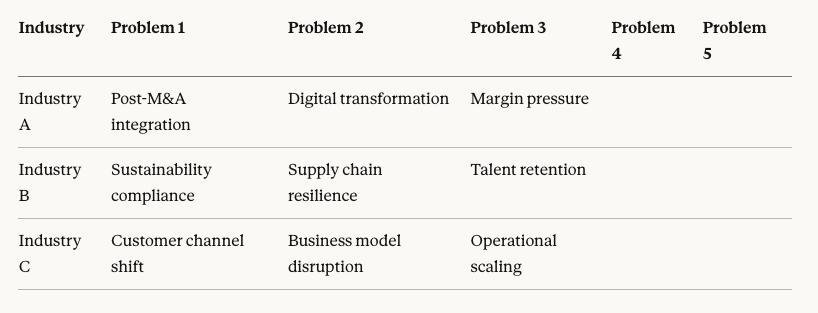
For your top 2-3 industries, research the most critical challenges:
Sources to check:
- Industry publications and trade journals
- McKinsey/BCG/Bain industry reports
- Earnings call transcripts from leading companies
- LinkedIn posts from industry executives
- Recent news (M&A, regulatory changes, disruption)
Sample problem categories:
- Regulatory disruption (compliance, new laws)
- Digital transformation (technology adoption, legacy systems)
- Sustainability pressure (ESG, carbon reduction)
- Market consolidation (M&A, integration challenges)
- Margin compression (cost pressure, pricing power)
- Talent/labor shortages
- Supply chain disruption
- Customer behavior shifts
Create a problem matrix:
Step 3: Problem Alignment with Your Strengths
For each pressing problem you identified, evaluate alignment with Exercise 2:
Does this problem align with my core strengths?
If your Exercise 2 core problem was:
- Growth Strategy → Look for problems like: market entry, new business models, strategic repositioning, product-market fit, M&A strategy
- Scale Operations → Look for problems like: post-M&A integration, operational scaling, transformation, multi-site coordination, complexity management
- Fast Execution / Efficiency → Look for problems like: margin compression, process optimization, cost reduction, supply chain efficiency, operational excellence
Filter questions:
- Does my unfair advantage (Exercise 2) actually help solve this problem?
- Can I explain in 2 sentences how I'd approach this problem differently from others?
- Do I have 2-3 examples from consulting where I solved similar problems?
Cross out problems where you don't have clear alignment. If none align, return to Step 2 and dig deeper into problems in your industries.
Step 4: Personal Connection & Motivation
For the remaining problems (those that align with your strengths), identify your personal connection.
Why does THIS problem matter to YOU?
Strong personal connections include:
- "I saw this problem destroy a client's business during a project."
- "My family member works in this industry and struggles with this daily."
- "I'm passionate about [sustainability/innovation/efficiency], and this is the biggest barrier."
- "I experienced this problem firsthand in my pre-consulting role."
- "This problem affects [community/cause] I deeply care about."
- "I've seen brilliant strategies fail because of this problem repeatedly".
- "This is the bottleneck preventing [outcome I believe in]."
Weak personal connections (avoid these):
- "This seems like a hot area" (trend-chasing, not genuine)
- "I did one project on this" (insufficient conviction)
- "I think I'd be good at this" (capability without motivation)
- "This sounds interesting" (vague, not compelling)
The test: Can you explain your personal connection in 2-3 sentences that would make someone remember you?
Step 5: Select THE Problem
You now have 3-10 problems across your industries that:
Align with your core strength (Exercise 2)
Exist in industries you know/care about
Connect to your personal motivation
Now pick ONE.
Selection criteria:
- Conviction Test: Which problem would you talk about passionately at a dinner party?
- Proof Test: Which problem do you have the MOST consulting examples of solving?
- Network Test: Which problem do you have contacts already working on?
- Longevity Test: Which problem will still matter in 5 years (not a fad)?
Your ONE problem: _____________________________________
Why this one: ___________________________________________
Step 6: Craft Your Problem Selection Statement
Template:"I want to help [industry/sector] solve [specific problem] because [personal reason], and I'm positioned to address it through [connection to unfair advantage from Exercise 2]."
Example:"I want to help regional hospital systems ($500M-$2B) solve post-acquisition integration failures because I saw a $500M merger nearly collapse due to poor operational planning during a consulting project—patients suffered and value was destroyed. I'm positioned to address this by translating private equity efficiency playbooks without compromising clinical quality, which is a rare combination that bridges financial discipline and healthcare operations."
Quality checks:
- Is the industry specific? (Not "healthcare" but "regional hospital systems")
- Is the problem specific? (Not "integration" but "post-acquisition integration failures")
- Is personal reason authentic? (Would someone remember this story?)
- Does it connect to Exercise 2? (Clear link to your unfair advantage?)
- Does it sound like YOU? (Not generic consultant speak?)
Exercise 4: Market Validation & Segment Prioritization
Objective
Validate that a real opportunity exists for solving your chosen problem (from Exercise 3) in specific market segments. This ensures your positioning is grounded in market reality rather than wishful thinking.
How to Complete
Important Context: You chose your problem in Exercise 3 based on interest and experience. Now you must validate that companies in growing, profitable segments are actually hiring to solve this problem. If they're not, it's best to pivot to an adjacent problem (still within your industry of interest) or choose a different industry entirely.
Note: It's still possible to target roles within an industry that is not growing. But you must accept that the job search might be longer and more challenging.
Step 1: Define Market Segments Within Your Chosen Industry
Take your #1 industry from Exercise 3 and break it down into specific sub-segments.
The goal: Find the most specific segments where your problem exists AND where companies have money + hiring appetite.
Use this AI prompt to help:
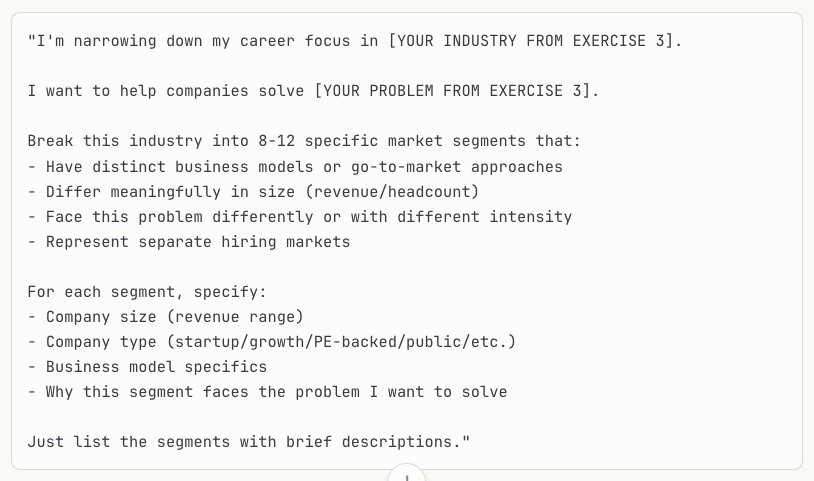
Example output:
- Industry: "B2B SaaS"
- Problem: "Scaling go-to-market operations when founder-led sales stops working."
- Segments:
- Series A-B ($2M-$10M ARR), product-market fit stage
- Series C ($10M-$50M ARR), scaling GTM motion
- Series D-E ($50M-$150M ARR), pre-IPO optimization
- PE-backed SaaS roll-ups ($20M-$100M ARR)
- Bootstrap profitable ($5M-$30M ARR), no institutional capital
- Public SaaS ($200M+ ARR), mature optimization... etc.
Select 5-10 sub-segments that seem most relevant to where your problem exists and where you have (or can build) credibility.
Step 2: Score Each Market Segment
For each segment, score on 6 criteria (1 = Low, 2 = Medium, 3 = High):
1. Growing? (Industry Growth Rate)
- High (3): Industry CAGR >10% or fast-growing sub-segment
- Medium (2): Industry CAGR 5-10%
- Low (1): Industry CAGR <5% or declining
Where to find data:
- IBISWorld industry reports
- Statista market research
- McKinsey "Big Arenas of Competition" report (download here)
- Public company investor presentations (growth projections)
- Industry association reports
2. Profitable? (Industry Margins)
- High (3): Average EBITDA margins >15%
- Medium (2): Average EBITDA margins 8-15%
- Low (1): Average EBITDA margins <8% or unprofitable
Where to find data:
- Public company financials (10-K, investor presentations)
- Industry benchmark reports
- CapIQ or PitchBook industry data
- "State of [Industry]" reports
3. Your Experience?
- High (3): 5+ consulting projects in this segment
- Medium (2): 3-4 consulting projects in this segment
- Low (1): <3 consulting projects in this segment
Be honest: Count only projects where you had meaningful exposure to companies in this segment.
4. Your Network?
- High (3): 7+ meaningful contacts in this segment (people who'd take your call)
- Medium (2): 4-6 contacts in this segment
- Low (1): <4 contacts in this segment
Who counts as a "contact":
- Former clients or colleagues now in this segment
- Business school classmates working in these companies
- People you've done informational interviews with
- LinkedIn connections who remember you positively
5. Hiring Trend?
- High (3): 10+ relevant roles posted in the past 3 months for your problem
- Medium (2): 5-9 relevant roles posted
- Low (1): <5 relevant roles posted
Where to search:
- LinkedIn Jobs (search role keywords + segment)
- Company career pages (check 5-10 companies in the segment)
- Wellfound (for startups)
- Industry-specific job boards
- Executive search firm postings
Example searches:
- "Head of Revenue Operations" + "[segment]"
- "VP Go-to-Market" + "Series C"
- "Director of M&A Integration" + "healthcare"
6. Career Capital Fit? (Connection to Exercise 1)
- High (3): This segment/role directly builds skills for my 5-10 year goal (Exercise 1)
- Medium (2): Tangentially relevant to long-term goal
- Low (1): No clear connection to career trajectory
Ask yourself: If I spend 3-5 years in this segment solving this problem, will I be positioned for my Exercise 1 career goal?
Scoring Table:
Create this table for your segments:
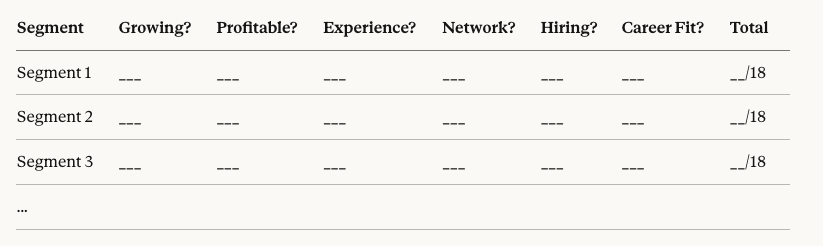
Minimum viable score: 14/18 to proceed
Interpretation:
- 16-18: Excellent segment—strong on all dimensions
- 14-15: Good segment—proceed with confidence
- 12-13: Marginal segment—validate heavily before committing
- <12: Weak segment—don't pursue unless other segments also score low
If all segments score <14: You have three options:
- Expand your segment list (did you miss viable segments?)
- Choose a different problem within the same industry (Exercise 3 pivot)
- Choose a different industry entirely (back to Exercise 3)
Step 3: Validation Research for Top Segments
For your top 2-3 scored segments, conduct deep validation:
A) LinkedIn Job Search:
- Search for role keywords related to your problem + segment
- Example: "Head of Integration" + "hospital" + "private equity"
- Count the number of relevant postings in the past 3 months
- Note which companies are actively hiring
- Target: Find 10+ relevant postings across your top segments
B) Company Identification:
- List 10-15 specific companies BY NAME in this segment
- Verify they match your target profile (size, stage, problem existence)
- Check if they're actually hiring (careers page, LinkedIn, news)
- Research recent news: acquisitions, funding, expansion (signals hiring need)
C) Informational Interviews:
- Reach out to 2-3 people working in this segment
- Ask: "Is [problem you solve] a priority for companies right now?"
- Ask: "What skills/backgrounds are companies looking for to solve this?"
- Ask: "Which 5-10 companies in this space are hiring for this type of role?"
- Validate your assumption that the problem is severe and hiring exists
D) Problem Severity Validation:
- Find 3-5 articles/reports discussing your problem in this segment
- Quantify impact if possible: "Post-M&A integration failures cost hospitals $X annually"
- Confirm this is a TOP 3 priority, not a "nice to have"
Step 4: Final Segment Prioritization
Based on scores + validation research:
Select your PRIMARY market segment (highest score + strongest validation)
- This is where you'll focus 80% of your job search efforts
- Your positioning statement will reference this specific segment
- Your target company list will be primarily from this segment
Select 1-2 SECONDARY segments (backup options)
- Scores 14+, moderate validation
- You'll pursue these if the primary segment isn't yielding results
- Keep them in your back pocket, don't lead with them
Step 5: Growth & Profitability Confirmation
Before finalizing, confirm your primary segment is actually healthy:
Growth confirmation:
- Segment CAGR: ____%
- Source: _________________
- Is this >5%? □ Yes □ No (if No, reconsider)
Profitability confirmation:
- Average segment margins: ____%
- Source: _________________
- Is this >8%? □ Yes □ No (if No, companies may not be hiring)
Red flags to watch for:
- Declining CAGR for 2+ years
- Widespread layoffs in the segment
- Regulatory existential threats
- Technology is making the segment obsolete
- Margin compression with no recovery plan
If you see 2+ red flags: Choose a different segment or problem, even if your personal interest is high. Passion in a dying market = unemployment.
Exercise 5: Supporting Conditions & Deal-Breakers
Objective
Define your non-negotiable criteria to filter opportunities efficiently and avoid post-offer regret.
How to Complete
Step 1: List Your Priorities
Rate each factor's importance to you (1 = Not important, 5 = Critical):
Compensation:
- Base salary range: $___ - $___ (minimum acceptable)
- Total comp expectations (including bonus/equity): $___
- Importance rating: ___/5
Work-Life Balance:
- Acceptable work hours per week: ___
- Acceptable travel % or days/month: ___
- Remote/hybrid/in-office preference: ___
- Importance rating: ___/5
Location:
- Geographic requirements: ___
- Max acceptable commute time: ___
- Relocation acceptable? Y/N
- Importance rating: ___/5
Company Characteristics:
- Company stage preference (startup/scaleup/enterprise): ___
- Company size preference (headcount): ___
- Industry/mission alignment importance: ___/5
- Brand/prestige importance: ___/5
Role Characteristics:
- Direct reports minimum: ___
- Budget/P&L responsibility: Y/N
- Required decision-making authority: ___
- Importance rating: ___/5
Growth & Development:
- Learning opportunities: ___/5
- Manager quality/mentorship: ___/5
- Clear promotion path: ___/5
Culture & Environment:
- Pace preference (fast-moving/structured): ___
- Politics tolerance (low/medium/high): ___
- Collaboration vs. autonomy: ___
- Importance rating: ___/5
Risk vs. Stability:
- Risk tolerance (startup volatility vs. corporate stability): ___/5
Step 2: Identify Your Top 3 Must-Haves
From all the factors above, what are your 3 MOST important?
Rank them:
Step 3: Identify Your Top 2 Deal-Breakers
What would make you absolutely miserable, even in an "impressive" role?
Examples:
- "More than 3 days/week travel"
- "Base salary below $150K"
- "No direct reports"
- "Company with <$50M revenue (too early stage)"
- "In-office 5 days/week."
Step 4: Define Acceptable Trade-Offs
What are you willing to sacrifice for what gain?
Format: "I'll accept [X] if I get [Y]"
Examples:
- "I'll accept 20% travel if base salary is $180K+."
- "I'll accept startup risk if I get VP title + meaningful equity."
- "I'll accept a smaller company (<$100M) if I get P&L responsibility."
List 2-3 trade-offs:
Exercise 6: Strategic Positioning Statement & Target List
Objective
Synthesize Exercises 1-5 into a compelling, differentiated positioning statement and an actionable target-company list.
Required Documents
- AI Prompt: Blue Ocean Positioning to Target Roles (Link/download here)
- Use this prompt with ChatGPT-4 or Claude to generate role titles
- Your completed Exercises 1-5 (from your worksheet)
How to Complete
Step 1: Craft Your Blue Ocean Positioning Statement
Formula: "I help [SPECIFIC market segment] solve [SPECIFIC problem causing SPECIFIC pain] by [UNFAIR ADVANTAGE] to achieve [SPECIFIC outcome]."
Pull from your previous exercises:
- Market segment = Exercise 4 (primary market segment)
- Specific problem = Exercise 3 (the ONE problem you want to solve)
- Unfair advantage = Exercise 2 (your archetype in one phrase)
- Specific outcome = What result do companies get? (quantify if possible)
Example: "I help mid-market PE firms ($100M-$500M AUM) with consumer/retail portfolio companies solve post-acquisition revenue stagnation by translating megafund growth playbooks for the mid-market context, typically unlocking 20-30% revenue growth in the first 100 days."
Quality checks:
- Is it clear what you do?
- Can you name 5+ companies that need this?
- Does it differentiate you from other consultants?
- Does it sound like YOU (not generic)?
- Does it ladder up to your Exercise 1 career goal?
Step 2: Generate Target Role Titles (Using AI)
Use the AI prompt with these inputs:
- Your positioning statement (from Step 1)
- Your resume (latest version)
- Your career capital goal (5-10 year target from Exercise 1)
- Your supporting conditions (Exercise 5)
The AI will generate:
- 5-10 specific role titles to target
- 2 career paths: "direct path" roles and "strategic path" roles
- Company size/stage recommendations
Example output:
- Direct path: Head of Portfolio Operations, Operating Partner, VP Value Creation
- Strategic path: COO (portfolio company) → Operating Partner → Partner
Validate the output:
- Search 3-5 of these role titles on LinkedIn
- Confirm 10+ real job postings exist
- Verify that these roles build toward your Exercise 1 goal
Step 3: Build Your Target Company List
Create a list of 10-15 specific companies (by name) where your positioning is relevant.
Sources:
- Companies from Exercise 4 validation research
- LinkedIn job searches for your role keywords
- Industry lists (e.g., "Top 50 B2B SaaS Companies")
- Portfolio companies of PE firms (if targeting PE value creation)
- Your personal network companies
Additional resources: check this guide to build your list, and this spreadsheet to organize it.
Categorize into tiers:
Tier 1: Dream Companies (3-5 companies)
- Perfect fit for positioning + career goals
- You have warm connections OR a strong company interest
- Example: "I'd take a pay cut to work here."
Tier 2: Strong Fits (3-5 companies)
- Clear fit for positioning
- May have 1-2 network connections
- Example: "This would be a great move."
Tier 3: Acceptable Options (3-5 companies)
- Positioning fits, but is less exciting
- Backup options
- Example: "I'd take this if Tier 1/2 doesn't work out."
For each company, note:
- Why positioning fits (1 sentence)
- Network connections (if any)
- Recent news/hiring signals
Step 4: Network Mapping
For your 20 target companies:
- Search LinkedIn for 1st and 2nd degree connections
- Document who you know (or who can introduce you)
- Prioritize companies where you have warm intros
Goal: Identify 3-5 people you can reach out to in the next 2 weeks
Step 5: Final Validation
Before committing to this positioning:
Market validation:
- Have you found 10+ job postings for relevant roles?
- Can you name 20 specific companies by name?
Network validation:
- Do you have 3-5 contacts you can reach out to?
- Can you get warm intros to 5+ target companies?
Skill validation:
- Does this positioning leverage your strengths?
- Can you prove your claims with 3+ examples?
Career capital validation:
- Do these roles build toward your 5-10 year goal?
- Are you excited about this path (not just capable)?